Rifle Shoppe
For The Rifle Shoppe telephone enquires please call:
Martin on 07595 477901
[Please leave a message on Voicemail and Martin will return your call as soon as possible.]
 Rifle Shoppe Reproductions
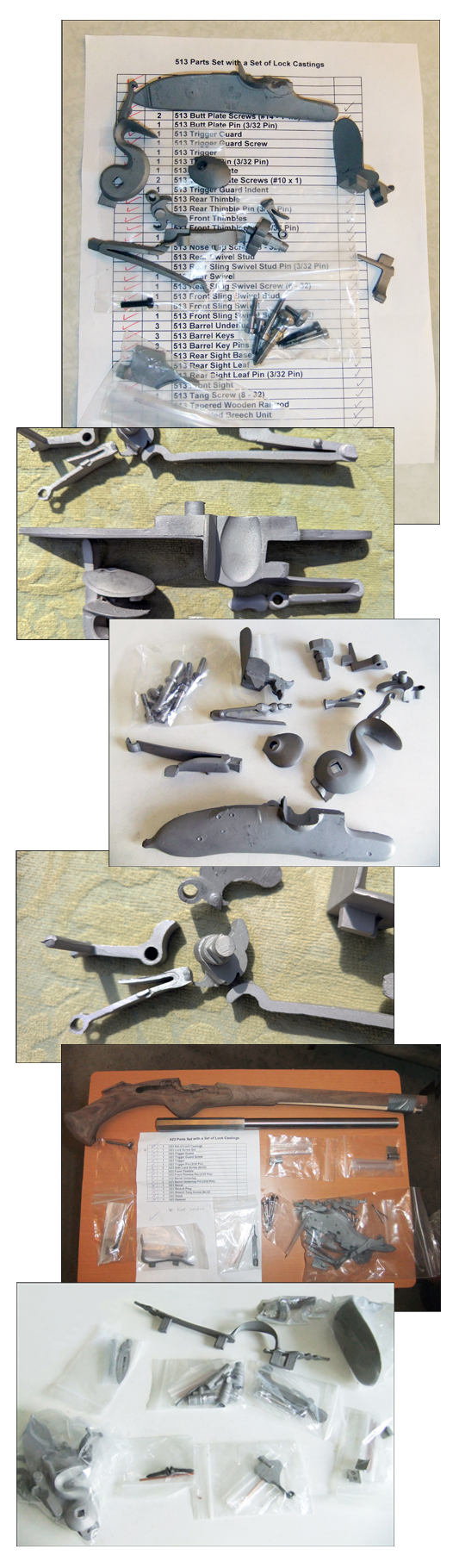 Aldhurst Arms, have been the sole UK importers for the entire range of The Rifle Shoppe products for the last twenty-odd years, and more recently have also accepted orders from various European countries and Australia.
The Rifle Shoppe is without doubt the best in the field for producing parts and kits for hundreds of distinct antique firearm models.
They were formed to produce exact replacement parts for a variety of antique weapons. These parts, where cast are taken from excellent condition originals using lost wax casting methods. Stock and barrel patterns when available, are the finest and most correct for each weapon produced. The resultant assembled firearms are highly regarded in the muzzle-loading community for their shooting accuracy and unparalleled appearance to originals.
As a consequence of our many years of dealing with TRS, and the large volume and range of kits we import from them, our special relationship means we are able to answer your email queries quickly; offer estimates in your home currency; and oversee your whole purchase from Oklahoma to your doorstep with greater efficiency than contacting TRS directly.
At one time TRS would assemble and finish their kits to order. This has not happened now for some years and we at Aldhurst Arms are pleased to offer gunsmith services should you require a completed kit or just a completed specialist part. For more information on our gunsmith services, see “Gunsmith Services” via the “About” menu on our website.
We have complied below a selected list of British Arms as shown in the TRS Catalogue with their descriptions. We selected these as they are generally the most asked for by our UK clients.
There is of course, also a wide selection of French; Spanish; German; Austrian; Dutch; Scandinavian; Russian; and US kits available; plus countless individual lock parts; furniture and accessories. [These are not listed here. For the full range of products please see the TRS website].
Hand Gonnes
The first of the hand held weapons were referred to as “hand gonnes” (cannons). They were a barrel (between .60 and .80 calibre) mounted to a pole. Although we think of Hand Gonnes shooting stone or lead balls, the earliest references show them shooting short stubby metal tipped arrows. There are “892 shefe’s of musket arrows” listed in the Tower of London inventory of 1589. Hand Gonnes were used from the mid 1300’s to the mid 1400’s. A painting dated 1411 in Austria shows an s-shaped lever (for holding the match-cord) attached to the wooden shaft so you could have more control of the weapon.
Hand Gonnes (793)
Our hand cannons are from the Dave Kroyer Collection. We are reproducing two different Hand Cannons (Gonnes). The first is a .62 calibre brass barrel that is very similar to the gun found in the ruins of Tannenberg Castle that was destroyed in 1399. The second is the more typical round .75 calibre barrel. These are finished barrels all you have to do is purchase the 1 1/8“ wooden shaft (available from most local hardware stores), between three and six feet long and lightly taper the one end to fit the socket. It is very surprising the accuracy that you can get with a little practice. We have been able to hit man size targets at 70 to 80 yards (8 out of 10 times).
Hakenbusche (855)

This is another Hand Cannon (Gonne) with a steel round barrel with rings for reinforcing, as some of the early hand cannon (gonnes) were cast, this type used a forged barrel. The rings were to make sure the barrel did not split from firing. This also has the Haken (hook) that some people think was use to lay over a wall in firing to absorb recoil, but even with heavy loads there is not much recoil to these weapons. It is more reasonable to think that it was used as a dual purpose to make the hand cannons (gonnes) usable as a hand to hand battle weapon for piercing bodies and armour. We offer pre-shaped and inletted stocks for this weapon or you can make your own. The barrel is 9“ in length and .75 Calibre. Can also be made without the hook. Many early Hakenbuchse Paintings show the s-shaped match-cord holder above used on these guns.
Matchlocks
The stocked matchlocks were in use from the late 1400’s until the early 1700’s. Most of them were made with smooth-bore barrels; however some were made with rifled barrels. The earliest known rifled matchlock was made for Emperor Maximilian I, between 1493-1508. It is also interesting to know that cloth patching was already a common thing by the early 1600’s. Around the year 1500, front and rear sights were more common, even on smooth bore guns. By the 1700’s, the British and French removed all the matchlocks from their forces. The shape of these early stocks may look odd, however they hold extremely well. In American writings of the early 1600’s, there were more references to matchlock muskets than firelocks. Many shooters today use cotton rope soaked in salt peter, but Nathaniel Nye wrote in 1647 on making good match cord, “Take cords of hemp that’s not very fine, or of toe, which is better, although it will sooner consume, and let every cord be as big as a man’s little finger, this done, boil the cords in strong lye, ashes and a little salt peter till all the lye be wasted, then dry”. We have tried match-cord from twisted hemp rope and it works much better than cotton rope. The majority of original match cord that we have observed is between 7/16″ and 1/2″ in diameter, both twisted and braided. We have always thought it would be a real challenge to actually hunt with a matchlock. We have a few customers that actually do bird and deer hunt with them. Craig Knobbe informed us that he has shot a deer every year for the past few years with his matchlock. Many of these early firearms were stocked in Ash, which we offer in addition to walnut.
Early Matchlock Caliver (527)
Right Hand Early Matchlock (528)
Left Hand Matchlock (681)
Snapping Matchlock (856)
Early Matchlock Caliver (779)
Dutch Matchlock (785)
Late English Matchlock (571)
Wheellocks
Wheellocks are first shown in Leonardo Da Vinci’s book from about 1508, but they seemed quite common by 1515, when a young Augsburg citizen had invited a handsome whore to a room, while there, he was fooling around with his self-igniting pistol when it discharged shooting her in the chin. Ben Vinto Cellini, (in his diary) talks about having to live in the Colosseum in Rome during the plague of 1526, states that he lived off of pigeons, rarely ever missing one at 200 paces with his wheellock rifle. If one studies the inventories of public stores and the archaeological sites of the early 1600’s America you will find there were a considerable number of wheellocks over here. Wheellocks are very fast and reliable ignition system, they were made all the way up to the 1820’s.
Early Germanic Wheellock Pistol (623)
German Wheellock (535)
Dutch Wheellock (629)
Early German Wheellock Musket (786)
Wheellock Fowler (682)
Paddle Butt Wheellock (587)
Snaplocks
The Swedish colonized an area of Delaware, Western New Jersey, and Eastern Pennsylvania in the 1630’s and according to George Moller the Swedish King sent five companies of infantry to help protect the Colonies, but the Dutch captured the Colonies in 1655 making them part of New Netherlands. The Swedes were armed with matchlocks and snaplocks.
According to M. L. Brown the first evidence of snaplocks is in the 1540’s and in 1556 they were refitting German Matchlock Arquebuses to take them.
Swedish Snaplock (685)
Early Russian Snaplock Hunting Gun (787)
Snaphaunce Weapons
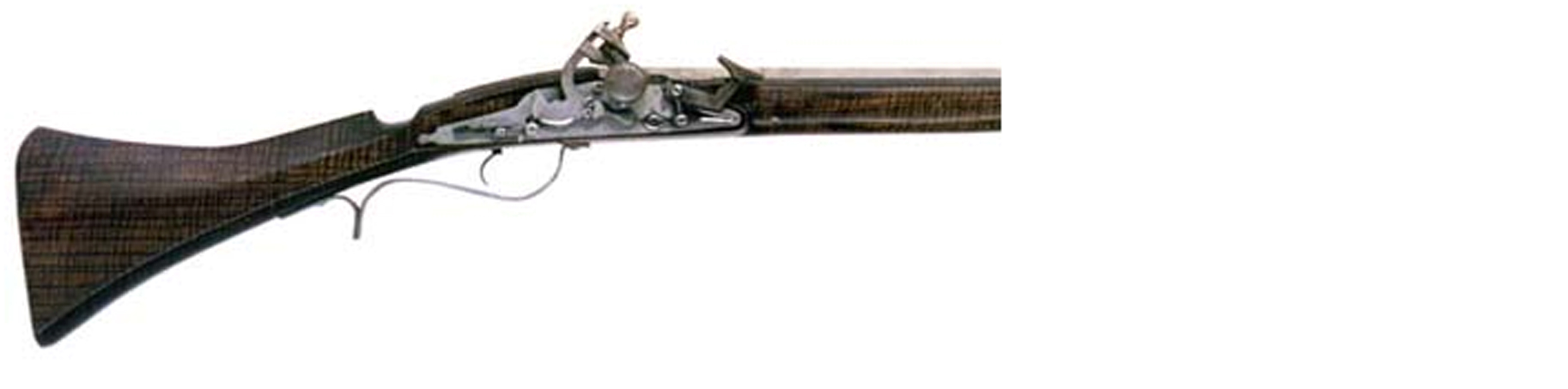 The Snaphaunce locks were developed in mid to late 1500’s being much simpler to make than the wheellock. The pan cover was still a separate sliding piece as on wheellocks and the sear arrangement is basically the same. The frizzen could be left forward as a kind of safety on guns without the sear locks. Large powerful mainsprings make these large locks very fast dependable sparkers. The Dutch, French, and English were the main users of these types of locks. Many of these guns were sent over to America in the early 1600’s as they were better suited for our needs of defence and hunting than matchlocks. George Moller has found that 1000 Snaphaunce muskets were sent to the Virginia Colony in 1702, so they were used quite late. Many Snaphaunce locks were fitted to matchlock muskets to update them. One Snaphaunce is listed on a raid to the new world in 1584, where a soldiers snaplock pistol dropped from his belt and went off upon hitting the ground and killing him.
1600’s English Snaphaunce Pistol (624)
Elizabethan Carbine Snaphaunce (525)
English Snaphaunce Musket (579)
Doglocks
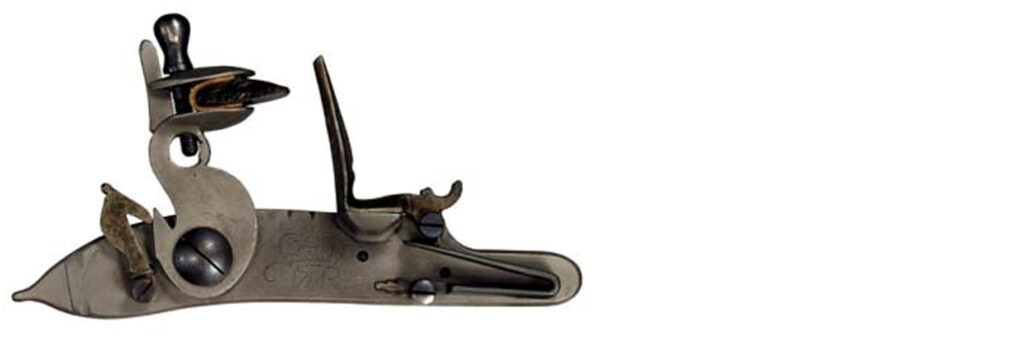
The English Lock, which appeared c. 1630, used a mechanism with characteristics of both older Snaphaunce and the True Flintlock, which was already being developed in France and Holland.
The English Lock frizzen and pan cover were combined in a single L-shaped unit but various sear mechanisms which were tried and proved to be unreliable. The older Snaphaunce could be rendered “safe” by swinging the frizzen away from the pan whose priming was contained by a separate, sliding pan cover. The English Lock had an integral frizzen and pan cover which was prone to accidental discharge if the sear became worn or faulty. To offset this mechanical deficiency the external catch or “Dog” was attached to the lockplate, close to the cock in such a way that it could secure the cock, most positive, when set at “half-cock”.
Towards the end of the 17th century the True Flintlock superseded the English Lock and the improved sear obviated the need for the dog nevertheless for another 20 to 30 years this extra safety feature was retained, until about 1720, especially on military muskets.
When the much refined “Brown Bess” was officially adopted as the English Government’s “regulation arm” c.1720, thousands of these older doglock guns still existed in serviceable condition. Some were used by the English Navy-notoriously parsimonious in matters of its supplies – great numbers were shipped to North American Colonies for military, general purposes, and trade use. Undoubtedly their rugged construction ensured their survival well into the second half of the 18th Century.
These muskets, predating the “Brown Bess”, they were plain sturdy guns with simple, almost crude, features: Locks were large, unbridled, and flat faced, held to the stock with three screws, incorporating heavy spring and reinforced ring-necked cocks and the pivoting dog catch. They were normally fully stocked (sometimes cut back a little at the muzzle) of ash, walnut, or other hardwood. There is no carving on the thick wrists and butts. Barrels might be either full round or octagon round (called squared), of varying lengths up to 46″ in .75 calibre. The tang screw was fitted from below. Furniture was very plain brass or iron. Flat butt plate simply nailed on. The flat side plate was typically of “serpent” form. Trigger Guards were either sheet metal or cast, with single nail or screw at the rear with barrel tang screw head supporting the front finial. Ramrod pipes were folded sheet metal with no entry pipe.
These distinctive features are truly represented in the models offered.
References: “Weapons of the American Revolution” (G. Neumann); “North-West Gun” (Hanson); “British Military Firearms” (Blackmore).
We have nice stock patterns available for the doglocks we offer. We also have a left-hand Doglock (735) available now. The (844) is a little more beefy than the others. The Cookson (553) and (735) is more of a semi-graceful early hunting gun even though at one time the locks were Military Pattern. Many of these doglock muskets were bought by the Hudson Bay Company and traded to the Indians. Many of their features carried on in the later trade fusils.
English Doglock Pistol (627)
John Burgers Doglock Fowler (669)
Cookson Doglock (553)
Left Hand Cookson Doglock (735)
Early Queen Anne Doglock Musket (844)
WR Doglock (554)
AR Doglock (560)
English Doglock Carbine (656)
Tiny Doglock Pistol Lock (596)
Early 1600’s Flintlock Pistol (626)
Hand Mortar (819)
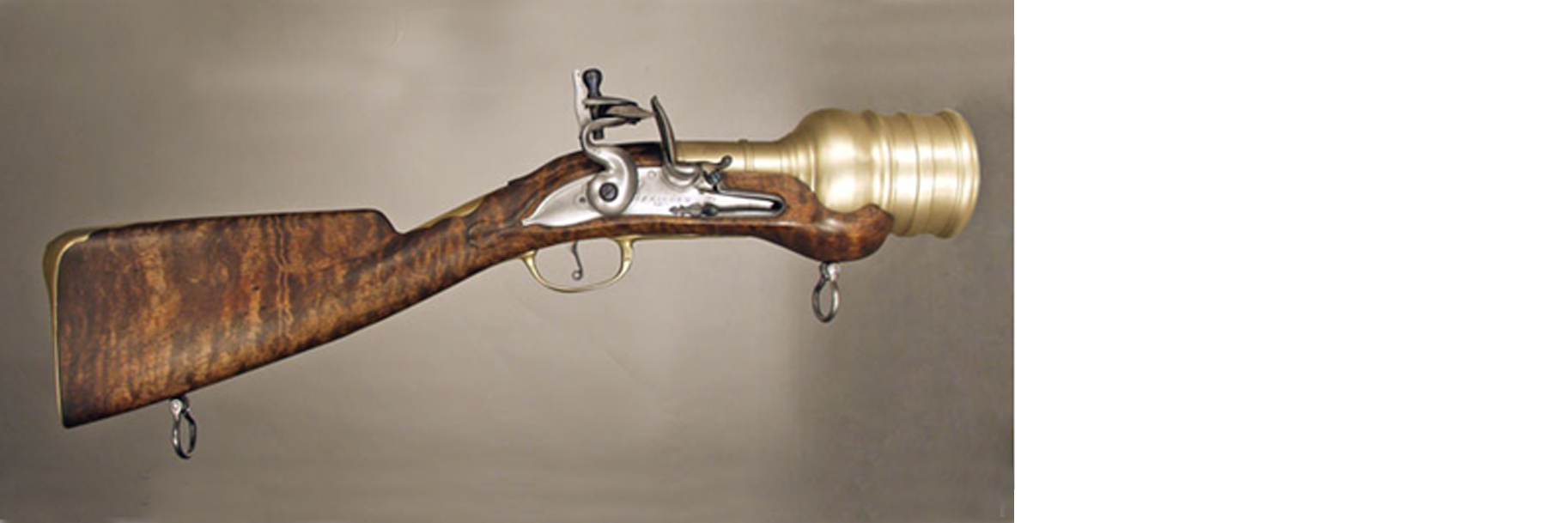
The earliest known Hand Mortars (grenade launchers) were Wheellocks of the 1580’s. The grenades were lit separately then the gun was fired to launch it. Ben Coogle shoots tennis balls from his and says it will send them two to three hundred yards. They were in widespread use by the 1680’s, grenadier’s became standard in all the Army’s of the world. The breech plug is fitted to the barrel. The length of the barrel is 8″ overall with a 2 1/2″ bore.
James II Musket (774)
This musket is from James II reign of 1685 to 1688. Nice early lateral sear flintlock marked “James II”. Early double step barrel in .77 calibres; 46″ in length. Unique stock styling with the very early stepped lock mouldings. The unusual lock on this musket must have been common at the time. We have noticed this same style lock on some Scottish muskets and 1680’s Norwegian Muskets. The original gun had an ash stock, which along with beech wood were very common gunstock woods at the time.
James II Carbine (676)
James II (1685-1688) was modernizing the British Army, this is one of the new flintlock carbines that was specified “…all made full carbine bore ye full length of 2′ 7″ every barrel, coloured blue with bridle lock.” We have reproduced this gun from the Pierre Cayla Collection. It is believed that some of these were shipped to Maryland in 1695. The lock is marked “Brooke”. The barrel is 31″ octagon to round; it is available in .62 calibre. The lock plate measures 6 1/8″ x 1 1/8″. The throw of the cock is 1 3/4″.
William III Musket (704)
During the reign of William III (1689-1702) the British ordnance system was trying to change over to flintlocks. This is one of the earliest muskets with a round face lock (Doglock Muskets were still being manufactured as late as 1715). It has a 46″ octagon to round barrel, available in .77 calibre. The lock plate measures 6 13/16″ x 13/16″. The throw of the cock is 1 7/8″.
Queen Anne Musket (638)
This is a musket from Queen Anne’s reign (1702-1714), that shows the blending of the Dutch and English styling into what would later become the Long Land Pattern. Furniture is all iron, the butt plate is bulbous, the thimbles are fancy, and the stock shows a minor curve from wrist to toe. The lock plate is marked W. Predden. Thanks to John Bosh for his assistance on this project. It has a 46″ tapered round barrel, available in .77 calibre. The lock plate measures 6 1/2″ x 1 3/16″. The throw of the cock is 1 7/8″.
George I Pre-Land Musket (636)
This is the Interim Musket after the Doglock. If you notice the stock styling is leading more into the standard Brown Bess pattern. It has a 46″ tapered round barrel available in .77 calibre. The lock plate measures 7 1/8″ x 1 1/8″. The throw of the cock is 2.
1728 Dated Early Long Land Pattern (542 A)
This set is available in either iron or brass mountings. We have recreated the stock pattern with the early full lock and tang carving in place, which did not start to disappear until the 1740’s. We have two lock markings available in this early single bridle lock, which are “1728 Tower” and “1724 Dublin Castle”. The barrel is a 46″ tapered round, available in .77 calibre. This pattern Brown Bess was made until the changes in 1742 and would have been the most common style during the French and Indian War, used all the way into the Revolutionary war. The lock plate measures 6 7/8″ x 1 1/4″. The cock throw is 1 15/16″ All of our locks and parts are full size and can be used on original weapons.
1756 Long Land Pattern (549)

This is the last of the Long Land series Muskets. This model has the metal ramrod and different thimbles. The lock is straight but still has only one screw showing behind the cock. The lock panels are plain with no carving or tear drops. The forearm is slightly fuller and the cast brass nose cap is standard on this model. It has a 46″ tapered round barrel; it is available in .77 calibre. The lock plate measures 6 7/8″ x 1 1/4″. Throw size 2″.
1744 Short Land Musket for Dragoons (728)

This musket was considered a carbine with its 42″ barrel. When first brought into service it had a wooden rammer with the early style lock plate. Notice the lock panel shaping and comb. Actually it is very distinctive in these features. These were made from 1744-1771 with the new straight lock being adopted in 1757. These were all manufactured with wooden rammers with the exception of two hundred which were made with metal rammers in 1749, using sleeved ramrod pipes.
Marine & Militia Musket (729)
In 1757, the Ordnance Department came up with this simplified musket to arm all new Marine & Militia recruits brought by the passage of the Militia Act of 1757. It was basically a trimmed down 1755 with a wooden ramrod, no thumb piece, no rear thimble and no nose cap. The butt plate finial was also changed, held in place with a screw instead of a pin. These guns were not required to be fine finished or polished. Barrels were 42″, side plates were flat mounted flush in the stock. In 1759 this version was changed to except a steel rammer with 1756 pattern thimbles an adding a nose cap.
1769 Short Land Pattern (Second Model) (674)
This model was officially introduced for use in 1769, for the British Infantry. This was basically an adaption of the Short Land Pattern for Dragoons with the exceptions of the ramrod pipes and steel rammer. It is similar to the 1755 with the exception of its 42″ barrel and new butt plate tang shape. Locks were large 1755 pattern with the single screw showing behind the cock until 1777 when the new smaller lock was adopted, which has two screws showing behind the cock and the new flat sided comb on the cock. The flat side plate was adapted in 1775. In 1779 there was a new flared 2nd thimble adaption called the Pratt thimble. Please specify which type of lock you have when ordering parts for original guns. The barrel is 42″ tapered round, in .77 calibre. Our Short Land stock pattern is set up for the early large lock and hardware as we believe it is doubtful that any of the later patterns could have been used in the American Revolution.
Pattern 1833 Manton Carbine (747)
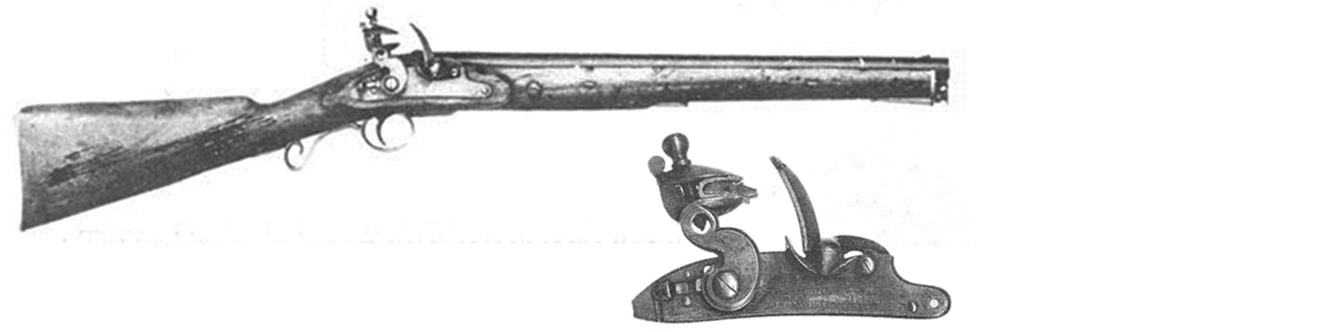
This carbine is the last official flint lock of the British Army and was a result of the trials that began in 1827. It is a composite of many ideas. It is .66 calibre with a 20″ barrel. The lock is very similar to Nocks screw-less lock but has an external hammer so moisture couldn’t creep into the lock mortise. The lock plate measures 5 3/8 ” x 1 1/8 “. The throw of the cock is 1 1/2 “.
1756 Long Land Pattern (549)
This is the last of the Long Land series Muskets. This model has the metal ramrod and different thimbles. The lock is straight but still has only one screw showing behind the cock. The lock panels are plain with no carving or tear drops. The forearm is slightly fuller and the cast brass nose cap is standard on this model. It has a 46 ” tapered round barrel, it is available in .75 or .77 calibre. The lock plate measures 6 7/8 x 1 1/4 Throw size 2.
Paget Carbine (601B)
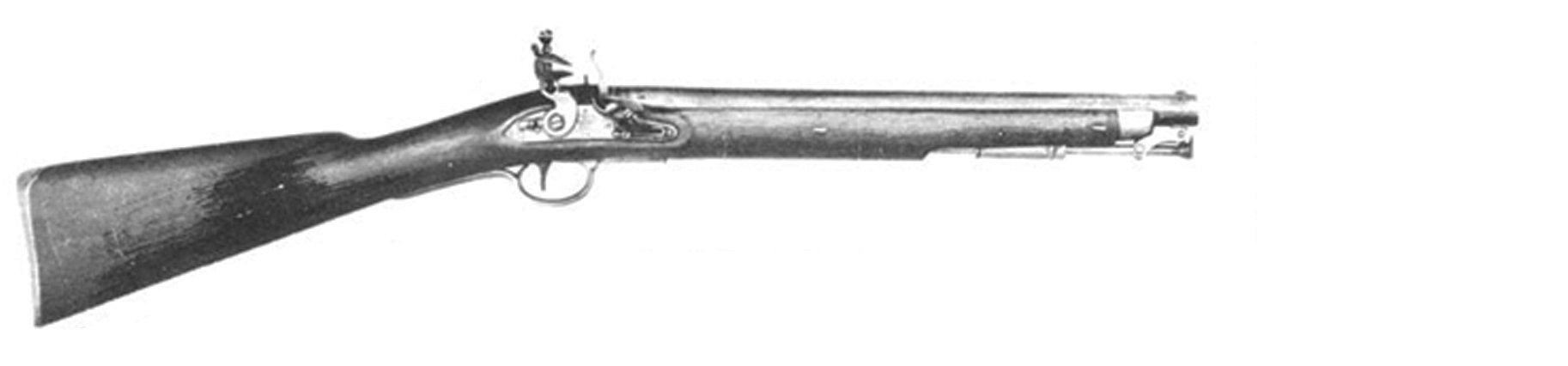
Adopted in 1808, this was the basic weapon of the English Cavalry till about 1830. Widely used during the Napoleonic Wars as were the Baker Rifle and Baker Carbine. This weapon was sold to Mexico and used against Americans. The Barrel is tapered round 16″ in .65 or .66 calibre. The lock plate measures 4 5/8 ” x 7/8. The throw of the cock is 1 1/4 “.
Flat Lock Carbine Bore Baker (714)

This is the most basic design Baker that was settled on and is the most common design that was used throughout the Napoleonic Wars. The very sturdy flat lock with beefy internals was used all the way to 1823. The tumbler has a fly so the trigger can be adjusted very light if desired. Heavy springs make this lock fast and dependable. The patchbox is the two compartment design with one compartment for pre-cut patches, the other for the cleaning jag and flints. You will find some of the later productions of this model with the rounded end patchbox.
We have reproduced this rifle, as it is considered the first and most predominate production pattern. The barrel is 30.5″ in length with a .62 calibre. The stock has just the right amount of drop and pull to make this the best handling of all the Baker designs. The lock plate measures 5 3/8 ” x 1 1/8. The throw of the cock is 1 1/2.
Round Lock Carbine Bore Baker (501)

Sometime after 1806 the smaller patchbox started appearing because they no longer were going to use separate patches and a loading mallet. Balls were going to be issued with patches tied around them. At first these patchboxes started appearing on flat lock guns. Then in 1823 the round faced 1796 carbine lock was re-adopted along with the new non adjustable rear sight. We also have the 1823 non-adjustable rear sight. These later Baker Rifles do not have quite as much drop or length of pull as the earlier Baker Rifles. The lock plate measures 5 1/4″ x 1” The throw of the cock is 1 1/2.
India Pattern Brown Bess (Third Model) (573)
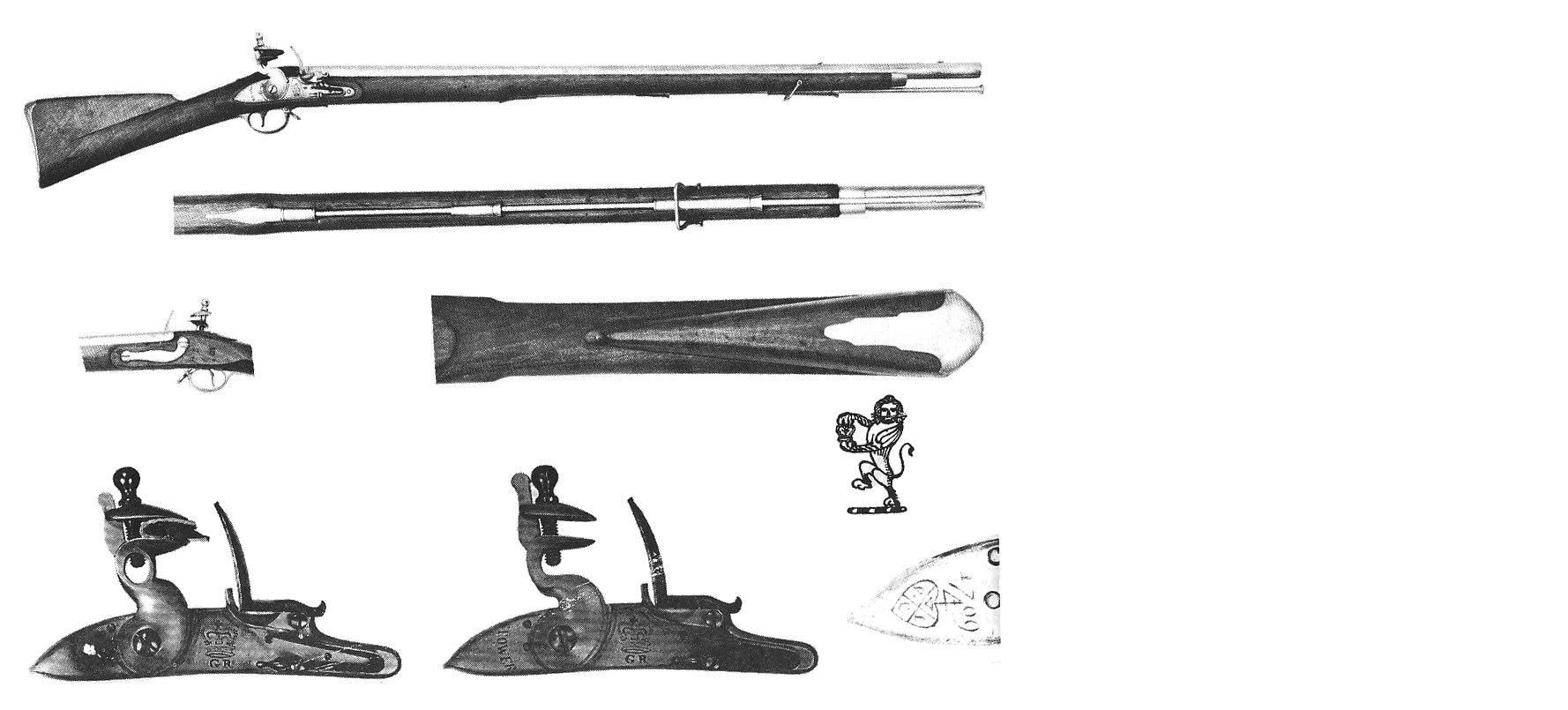
The India Pattern Musket was originally made for the East India Company, but in 1793, the English were very short of arms and decided to adopt the East India Pattern which was easier and cheaper to make, with simplified a butt plate, trigger guard, and side plate. Deleting the thumbpiece and one thimble. The barrel was also shorter. It has a 39″ tapered round barrel in .77 calibre. It originally had a gooseneck cock; in 1809 they started producing the ring-neck cock (double throated cock). On weapons made for the British Military the lock markings are still standard military markings with Crown and GR. On early production guns the stocks were much fuller and similar to the Second Model stock in thickness, later production guns were thinned down – we offer both stocks. On weapons made for the East India Company the lock markings on the Muskets were the 4 quartered heart with the letters “V” (United), “E” (East), “I” (India), “C” (Company) with a cross or the figure “4” at the top (the cross was changed because of Moslem objections). The contractors name was engraved in the centre and the date above the heart. In 1810 these markings were changed to the standing lion hold a crown as shown above. The lock plate measures 6 3/4″ x 1 3/16″. The throw of the cock is 1 7/8″.
New York City Contract Brown Bess (671)
In 1755, the people of New York City were afraid that the French were going to attack at any time (French and Indian War) so they contracted for 1,000 muskets for use by the city inhabitants. These guns were branded and marked “NY” with the regiment number. Paul Ackerman of West Point Museum was instrumental in this project making sure all the patterns and engraving were perfect duplicates of the original. This weapon was originally a Long Land, which was shortened to the Short Land configuration at some point after it was made. This gun is reproduced exactly as it is in the Museum at West Point. The butt plate and trigger guard are quite different than a standard first model. The lock is simply marked. “Wilson”. It has a late front thimble for an iron ramrod. These New York muskets were carried in General James Abercrombie’s assault on the French Fort Carillion at Ticonderoga, they also were carried by the New York Regiments that attacked Montreal. The lock plate measures 6 7/8″ x 1 1/8″. The throw of the cock is 1 15/16″.
Regimental Contract Brown Bess (857)
Up until 1740 each regiment’s Colonel could procure it’s muskets as long as they were close to the standard pattern. During this time some very nice muskets were made. We located and added one of these contract pieces, it is in all respects exactly the same as the Ordnance pattern, but it has slightly slimmer proportions and is a very striking piece. The trigger guard is slightly slimmer in size; most other hardware is the same size as our (542). The stock is much more graceful in handling. It has a 46″ tapered round barrel, in .77 calibre.
1738 Sea Service Musket (551)
Thanks to Phil Ackerman and Richard Colten we now have complete patterns for the Sea Service Musket. These were standard muskets aboard ships and standard use by foot Marines. There have been a number of parts for these turned up in revolutionary battle sites and digs. Barrels came in two lengths 37” and 46” in .77 calibre, we offer both. These were originally stocked to the muzzle but in 1752 the fore-end was cut back to be fitted with bayonets and sling swivels. These weapons had a file finish with metal and wood blackened until 1757 when the weapons were made bright finished or black finished. In 1757 they did away with the rear lock retaining screw and changed the side plate to the Marine and Militia pattern. These were manufactured and issued beyond the Revolutionary War. These are very sturdy well built muskets. The barrel is 37″ or 46” tapered round, available in .77 calibre. The lock plate measures 7 1/2″ x 1 3/16″. The throw of the cock is 2″.
1778 Sea Service Musket (791)
This later version of the Sea Service Musket with a rounded lock is basically the same as the early pattern, with the exception that a spring has been added to the ram rod pipe to hold a steel ramrod, and the 1777 pattern lock is used. Sea Service muskets do not use a trigger plate or nose cap. A small square nut is in-letted in front of the trigger for the tang screw. Barrel is 37″ tapered round in .77 calibre. The lock plate measures 6 3/4″ x 1 3/16″. The throw of the cock is 1 7/8″.
British New Land Musket (686 A)
This musket was introduced in 1802 and was the most modernized and simplified of all previously produced British Muskets. Easier to produce and extremely well designed. The stock comb now blends into the wrist instead of joining it; there is no carving at all around the lock or tang. The lock is completely new, flat faced with a raised or semi water proof pan. The 42″ tapered round .75 calibre barrel is held by three keys. The lock plate measures 6 7/8″ x 1 1/4″. The throw of the cock is 1 3/4″.
New Land Light Infantry Musket (686 B)
This design was approved in 1803, but was not produced until 1810. A notched rear sight was brazed to the barrel though it still used the bayonet lug as the front sight; a pistol grip trigger guard was also added to this weapon. The barrel was shorted to 39″ as compared to the British New Land Musket above. The lock plate measures 6 7/8″ x 1 1/4″. The throw of the cock is 1 3/4″.
1744 Horse (Cavalry) Carbine (790)
This is one of the earliest Land Service Carbines. It has a 37″ tapered and flared barrel in .62 or .66 calibre. Basically all furniture is a reduced size Brown Bess. The lock is an early curved style reduced size, marked Vaughan (who died in 1745). This carbine was first produced with a wooden rammer. The stock has full carving around tang and lock panels. Sling bar is mounted on left side. The lock plate measures 6″ x 1 1/16″. The throw of the cock is 1 11/16″.
1756 Horseman’s (Cavalry) Carbine (730)
This Carbine is basically the same as the 1744 above, but it uses the new 1756 straight pattern lock. The furniture stayed the same until 1779 when the new composite front thimble and the newer 1777 pattern lock was adopted as shown in this picture. There is no longer any carving around the lock panels. The barrel is 37″ tapered and flared, in .62 or .66 calibre. The lock plate measures 6″ x 1 1/16″. The throw of the cock is 1 5/8″.
1756 Royal Artillery Carbine (711)
This carbine is very similar to the Horseman Carbine except it is fitted with sling swivels, and the stock is cut back for a bayonet, it has no side sling bar. The barrel is now tapered and lighter in weight. The very first ones made had wooden rammers, but most were altered for steel ramrods by putting a bushing in the front thimble and a spring in the rear thimble. In 1776 the new carbines were made just for steel rammers using either the composite front thimble or the long plain front thimble. In 1777 the new pattern lock was adopted with the plain front thimble. Barrel is 37″ tapered round, in .62 or .66 calibre. The lock plate measures 6″ x 1 1/16″. The throw of the cock is 1 3/4″.
Eliott Carbine (696)
 In 1760 this carbine was designed by General Eliott for the 15th Light Dragoons. Originally it was full stocked to the muzzle with a wooden rammer. In 1772 they were converted to metal rammers. In 1773 the Eliott was adopted for all dragoons in the configuration shown here. Note the new style ramrod that engages a lip on the fore end cap. This carbine is now adapted to take a bayonet. The barrel is 28″ tapered round, in .62 or .66 calibre. The lock plate measures 6 1/8″ x 1 1/16″. The throw of the cock is 1 11/16″.
Sergeant of Grenadiers Carbine (632)
The 1770 Sergeant of Grenadiers Carbine has a 39” barrel in .62 or .66 calibre and use the standard land pattern carbine furniture with the exception of the oval thumb-piece and the Eliott carbine type side-plate.
1740’s Light Fusil (578)
These light fusils keep showing up in American Collections. They have the early banana shaped locks and are dated in the early 1740’s. They have 42” round barrels in .66 calibre. The furniture is exactly the same as First Model Brown Bess in reduced carbine size. These are possibly the light fusils that were issued during the French and Indian War. Very slender fusil with 1742 dated lock.
1756 Light Dragoon Carbine (592)
One of the smaller carbines brought in during the Seven Years War (French and Indian War); it had a 36″ barrel making it much easier to handle by a mounted troop. The Late Kit Ravenshear had provided us with perfect pattern pieces from his collection; we were able to reproduce the weapon exactly as it should be. Basically all furniture is scaled down Long Land pattern. This gun is very similar to the Artillery Carbine with the exception of the pinched in bow on the trigger guard, it also has a side sling bar. The Barrel is 36″ in .62 or .65 calibre. The lock plate measures 6″ x 1 1/16″. The throw of the cock is 1 5/8″.
Nocks’s Pattern Muskets & Carbines (745)
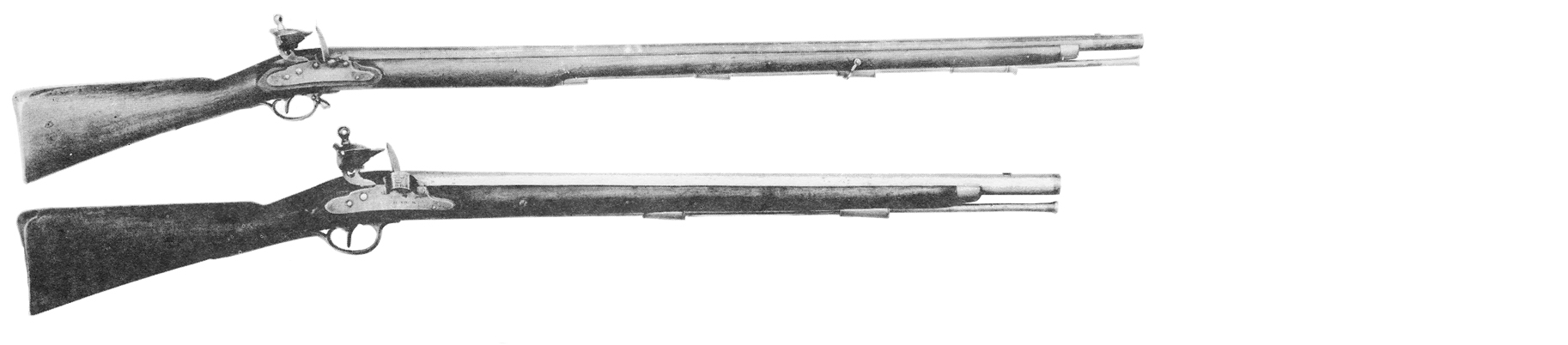 This musket size Nock lock is for the 1792 and 1794 Duke of Richmond musket and the 1796 Heavy Dragoon Carbine. We have a rifle size lock listed on page 58. The lock plate measures 5 1/2″ x 1 1/8″.
Light Infantry Fusil (593)
According to DeWitt Bailey the first Light Infantry Fusil was Lord Loudoun’s 1745 pattern. These fusils used a very unique pattern of furniture. Basically these are a smaller, light weight version of the full size musket. The one we reproduced here is the latter version with the 1756 pattern lock. It has a 42″ tapered round barrel, in .62 or .66 calibre. It was set up for a wooden rammer. These are very slim weapons and handle more like fowling pieces than military guns. The lock plate measures 6″ x 1 1/6″. The throw of the cock is 1 5/8″.
1796 Heavy Dragoon Carbine (865)
This carbine was designed with the idea of standardizing the calibre to be able to use musket ammunition. It has the full slit stock ramrod groove to trigger guard so dirt and mud would not lock the ramrod in or out. Examples are known with either sling swivels or side sling bar with a 26″ barrel, in .77 calibre. This was the standard issue Dragoon Carbine until the late 1830’s.
1807 Sergeants Carbine (788)
This carbine was made especially for NCO’s who needed a lighter, shorter weapon. Except for smaller dimension it is very similar to the India Pattern Musket. This weapon is the same as the India Pattern Artillery Carbine which has a 39″ barrel compared to the 37″ barrel on this gun in .62 or .66 calibre. The lock plate measures 6 1/8″ x 1 1/6″. The throw of the cock is 1 11/16″.
Paget Carbine (601B)
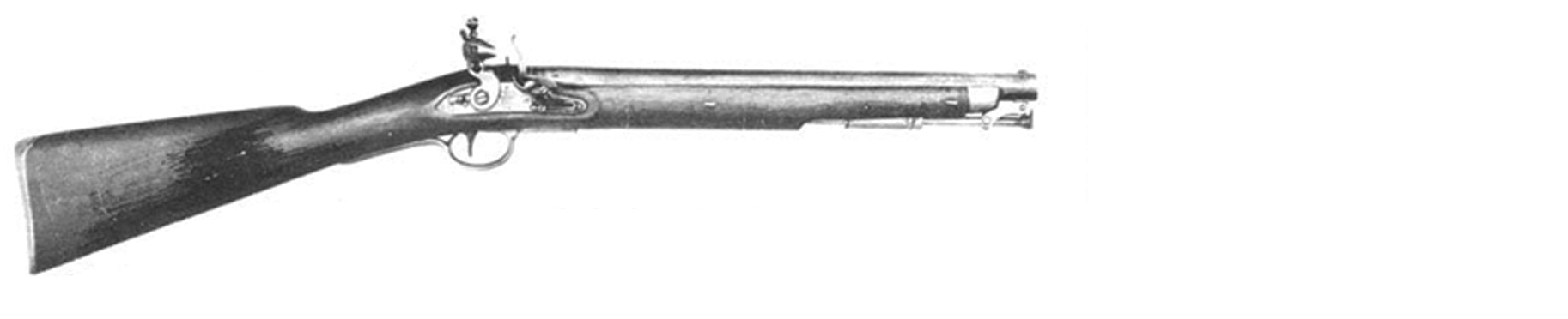 Adopted in 1808, this was the basic weapon of the English Cavalry till about 1830. Widely used during the Napoleonic Wars as were the Baker Rifle and Baker Carbine. This weapon was sold to Mexico and used against American’s. The Barrel is tapered round 16″ in .65 or .66 calibre. The lock plate measures 4 5/8″ x 7/8″. The throw of the cock is 1 1/4″.
1776 British Rifle (509)
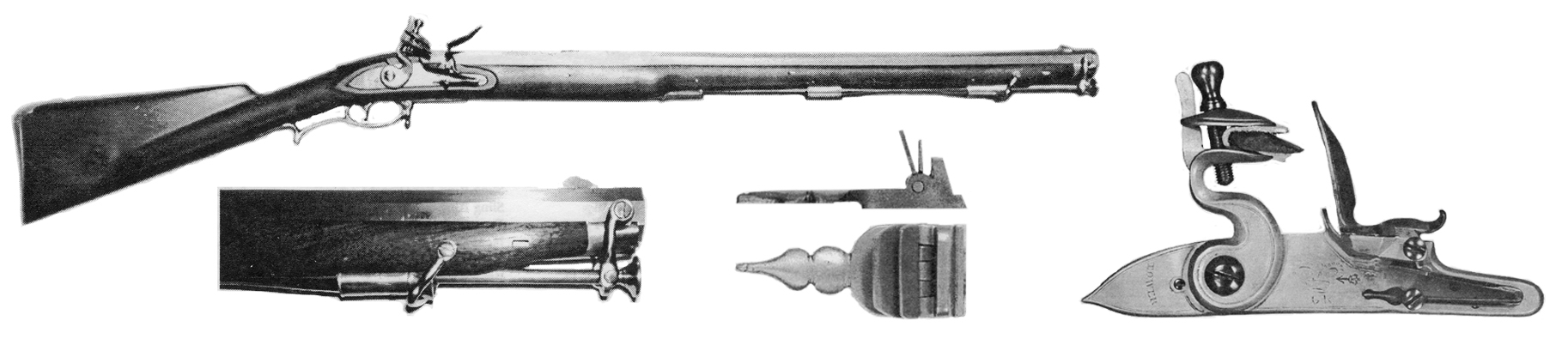 In January 1776, orders were sent to have 1000 rifles built for the British Army to confront the American Riflemen. This was the first British Rifle to be used in America. There were 800 of these that were delivered thru 4 Birmingham makers – William Grice, Mathias Barker, Galton & Sons and Benjamin Willets. There were 200 more delivered from Hanover, Ernie Cowan believes that they have just identified one of these. It has a 3 leaf rear sight and Jaeger styling. This rifle is a much over-looked weapon used all during the Revolutionary War. It has far more historical significance than even the Ferguson Rifle as it was probably present at most all the conflicts during the war. Thanks to the Late Kit Ravenshear and Herman Benninghoff we are now able to supply all the hardware for this rifle. It is brass mounted and has a very unique swivel ramrod arrangement. The barrel is 28.5″ with hook breech in .62 calibre bore. In the book by DeWitt Bailey “British Rifles 1740-1840” he goes into great detail on this very famous rifle. The lock plate measures 5 3/4″ x 1″. The throw of the cock is 1 5/8″. We also have the British Rifleman’s powder horn spout that was mounted on horns issued to rifleman before the Napoleonic Wars later in the section on English Arms.
Ferguson Rifle (513)
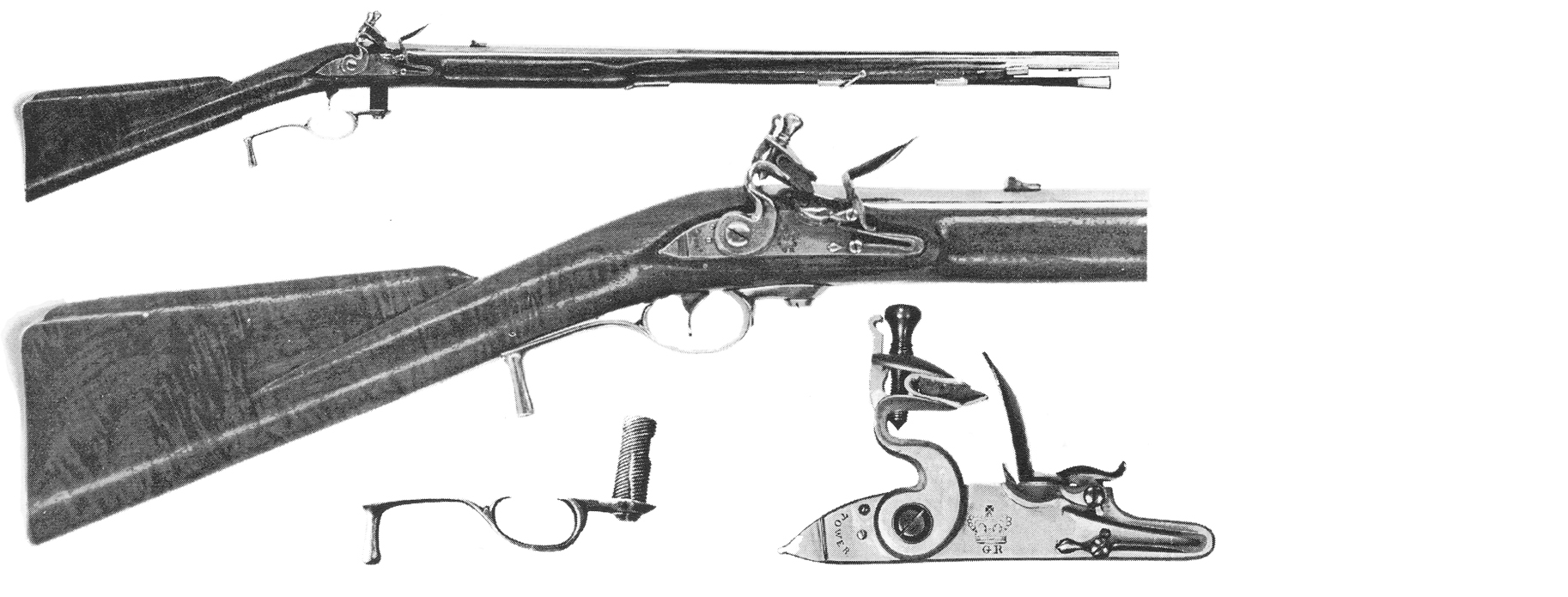 The Ferguson Breechloading Rifle was basically an improvement of the older La Chaumette design of the 1720’s. Ferguson added an extension to the bottom of the barrel to keep the breech screw from falling out when loading and added grease grooves to the breech screw to help with continued firing. One hundred of these rifles were made and sent to America with Ferguson. There are only two surviving specimens known, one in the Morristown, New Jersey, National Park Museum and one in the Milwaukee Public Museum. We made our patterns from the Milwaukee example as it was in far better condition. This is one of the best museums in our country and we advise anyone who is in that area to stop in and visit. Their staff were wonderful people to work with, going far beyond normal duty to help us with this project. We have produced all parts for this gun and we have gone the extra mile on these rifles to make sure they are 100% correct, even with the original proof marks and correct rifling. We do not stamp these original style proof marks on barrels unless they are requested by the customer when order is placed. If you would like us to stamp the original style proof marks on the barrel it is an additional $75.00 labour charge. The original military breech screw used 11 independent threads not 10 threads as the sporting models do. The breech screw is also tapered considerably to keep the screw from binding. We have also reproduced the original 30″ bayonet which was designed for use as a sidearm (the blade projects directly from the side of the socket for balance). The lock plate measures 5 1/4″ x 15/16″. The throw of the cock is 1 1/2″. The Ferguson Rifle has a calibre of .65 with deep fast twist (1 in 56 Twist) rifling. The powder chamber holds 72 grains. The barrel and breech assembly is finished. The tapered 11 thread plug is fitted w/square cut for trigger guard. We can cut the (4) dovetails for the under-lugs and rear sight, and braze the front sight and bayonet lug on for an additional $150.00.
Musket Bore Baker Rifle (725)
This is a real man’s rifle in a musket bore .69 calibre. This early production style with round face lock and squared off patch box, has a slightly thicker wrist and butt stock than the carbine bore guns. The .69 calibre was dropped in 1803 probably because of complaints of recoil. The lock plate measures 5 1/4″ x 1″. The throw of the cock is 1 1/2″.
Left Hand Baker Rifle (694)
We’ve had many calls for left-handed guns, so we decided to produce a few in the more popular types of weapons. While we were working on these left hand patterns a gentleman came into our shop with a left hand Baker rifle lock. I would have never thought of one being made but as it turned out this completed our patterns. This rifle is an exact duplicate of our series 714 first pattern Baker rifle except it is for left hand shooters. The cheek piece is on the correct side for left hand as is the patch box. The bayonet lug is still on the right side so the standard Baker bayonet may be used. The barrel is 30 ¼”, in .62 calibre. This has a very quality lock.
Baker Cavalry Carbine (601A)
 Adopted in 1803 for the Light Dragoon and Cavalry is this Baker Carbine with a rifled bore. Made identical to the rifle but smaller in size with a 20″ barrel in .62 calibre. This Carbine has a side sling bar. The lock plate measures 4 5/16″ x 1 5/16″. The throw of the cock is 1 5/16″.
Nock’s Screwless Rifle Lock (746)
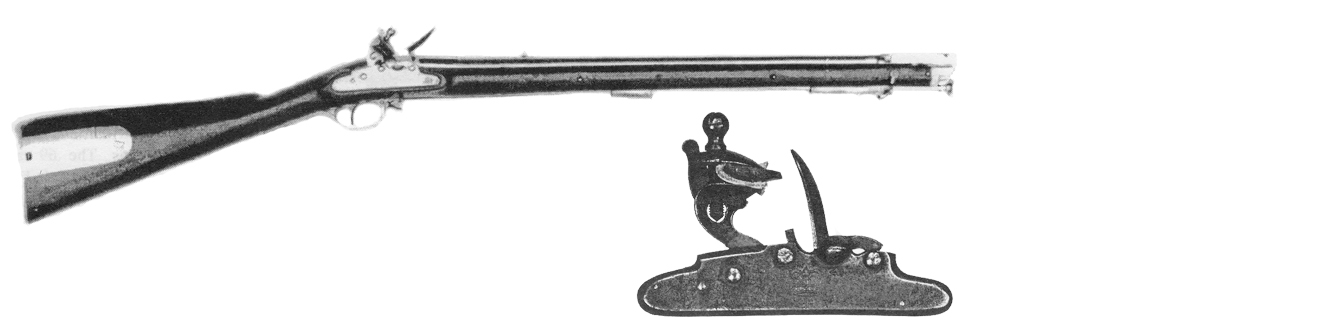 This is the smaller Nock Lock that was used on the Volunteer Baker Rifles. The Lock plate measures 4 3/4″ x 1 1/16″
Nock Volley Gun (789)
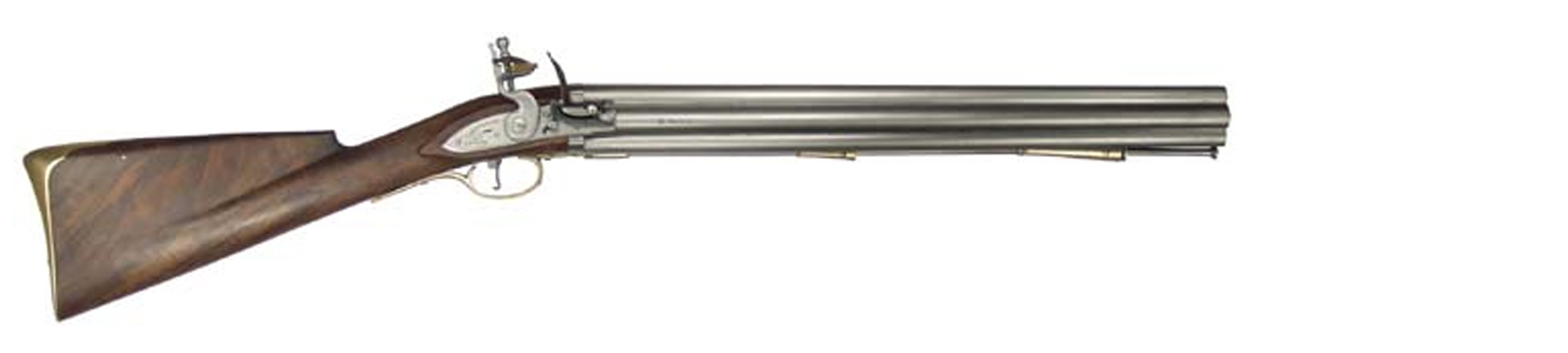
In 1780 the ordinance department ordered 500 of these seven barrel Nock Volley Guns. The first 3 of these weapons were rifled, but it was found that the rifling was not necessary so all later models were smooth bore. There are 6 outside barrels located around a central barrel. The barrels are 20″ long in .50 calibre. After removing the lock, the barrel section unscrews from the breech unit. The central barrel fires the outside barrels. There was another 106 made up after the Revolutionary War and delivered in 1788, these will have a double throated cock and standard frizzen spring. The original powder charge was 40 grains which I thought was very light but upon firing one of these guns with a 40 grain powder charge in each barrel the recoil is tremendous and when you think about 40 grains times seven barrels equalling 280 grains with seven .50 calibre lead balls which would be 3 1/2 inches of lead that is a tremendous charge, I did not shoot it a second time with the 40 grain charge.
First Model Brunswick Rifle (673)

The first percussion rifle adopted by the British and approved in 1837. The original was a 2 grooved barrel shooting a belted ball in .62 calibre, but when production started the calibre was changed to .70 so they could shoot a musket ball if needed. The barrel is 30 3/16 “. Many thanks to William Marean who supplied us the pattern rifle and research for this project. These rifles remained in use until the 1850’s. We also have the Russian version of this rifle listed later in this catalogue. Bayonets for this rifle are listed in the bayonet section.
Second Model Brunswick (864)
 The new lock was adopted in 1841 according to De Witt Bailey, but it was not until 1845 that any quantities of it were produced. The hook breech and other parts remained the same.
1838 Percussion Musket (859)
The first official Percussion Musket of the British Army’s designed by George Lovell was one of the best designs of the period. It featured a hook breech, keyed barrel and the sturdy Lovell back action lock. The barrel was 39″ in .75 calibre.
1839 Percussion Musket (860)
It was decided in 1838 that in the Tower there was an abundance of parts that could be used to save money over producing the completely new 1838 weapon. Hence forth the 1839 was born. The earliest production used lock plates converted from flintlock, but by the mid 1840’s new lock plates were being made. The square on the tumbler for the hammer was discontinued on these locks. The tumbler shaft was left round and the hammer was positioned with a pin to lock the hammer in the correct position. You will find these with a variety of markings up to 1850. They were still being produced even after the 1842 came into being. The barrel is 39″ in .75 calibre. The 1839 did not have a rear sight and pins were used instead of keys. The model 1839 was also produced in a Sea Service version with a 30 1/4″ barrel.
1842 Percussion Musket (861)
 This was the last percussion smoothbore musket; it has an all new lock. The barrel has a rear sight and is set in with (3) keys. The side lock screws use the small brass cups instead of a side plate. These were made until 1853. Between 1852 and 1855 over 26,000 were rifled and fitted with long range rear sights. The barrel is 39″, in .75 calibre. There were also Sea Service versions rifled with a 30 1/4″ barrel.
1851 Minie Rifle (862)
This is the first rifled musket of the British army, very similar to the pattern 1842 except it is a little slimmer in size. The barrel calibre was reduced to .70 with 4 grooves and 39″ in length. The barrel was also retained with keys. There were approximately 35,000 made. The long range rear sight was sighted for 900 yards. This rifle made a grand showing in the Crimean War where it preformed exceedingly well.
1853 First Pattern Enfield (736 A)
The First Pattern Enfield used screw clamping bands, the rear sight has rounded sides, a button head very thin ramrod, the stock also has a very narrow groove for the ramrod and the hammer has a very pronounced curl. Locks are dated 1854 to 1855. The rear sight has rounded swelled sides.
Second Pattern 1853 Enfield (736 B)
As a result of complaints from the battle field of the Crimean War several modifications were made from the 1853 First Pattern Enfield resulting in the Second Pattern. The bands were changed to solid bands secured by band springs. The sides of the rear sight are now flat opposed to round on the first model. The wide front band helps hold the new improved ramrod in place, the ramrod now has a cleaning jag on the head and has a pronounced swell below the head to help hold it in place, still being a narrow rod. Locks are dated from 1855 to 1858.
Third Pattern Enfield (736 C)
This is the most common of the Enfield’s; it was manufactured between 1858 to 1863 by many contractors, at Enfield and London Armory. It is distinguished by a thick body jag head ramrod, a return to the screw clamping bands, and a much wider ramrod channel groove. The nose cap is also held on by a screw in this 3rd model. This is also the first model to use progressive depth rifling.
Pattern 1856 Short Rifle (736 D)
The Short Rifle had a 33” barrel; they were issued to all Sergeants of Line Regiments and to the Rifle Regiments. They used two clamping bands, the furniture is all iron.
British Cavalry Carbine Pattern 1856 (783)
This short 21” barrel cavalry carbine has a swivel ramrod and side sling bar.
Snyder Rifle (773)
The Snyder Conversions were adapted in 1866. They were made by removing a few inches of the barrel breech and adding a new breech section. The first model was called Mark 1. The Mark II came out in the first part of 1867 it used a slightly larger breech block and the extractor was altered. The hammer nose was also cupped out. The Mark III came out in 1868 and was on all new manufacture using a locking latch button to lock the now steel breech block closed and steel barrel instead of Iron. The hammer nose is now again flat instead of cupped.
Mark III Snyder’s were mainly new production guns with the improved locking breech block. These have a latch button on the Left underside of the block. All Mark III’s will use the laidly pattern bands.
Early “Twigg” Officers Fusil (569)
From the restoration of Charles II to the English throne in 1660. “Field Shooting” became a popular sport among gentry. By the middle of the 18th century the “fowling piece” had developed into a most graceful, slender, and full stocked form. This sporting gun became the pattern for this new class of lightweight military arms. Modifications made were attachment of sling swivels, the cutting back of the end of the forestock so that a small socket bayonet could be accommodated, the adoption of the new “carbine bore of .66 calibre” became standard, and usually an iron rammer instead of a wooden one. The standard barrel of this period was octagon to round with the fowling piece bores ranging from 20g. (.62) to 14g. (.69). Brass mounts were typical, often decorated with military motifs when fitted to the fusils. Some fusils were rifled.
This Officers Fusil by “Twigg” is a very nice example of one of these. It has a small bayonet that fits into the butt stock, which has a butt plate with a trap door. The lock plate measures 5 9/16″ x 1 9/16″. The throw of the cock is 1 9/16″. The barrel is a 42″ octagon to round, available in .69 calibre or in 12 gauge.
British Wall Gun (727)
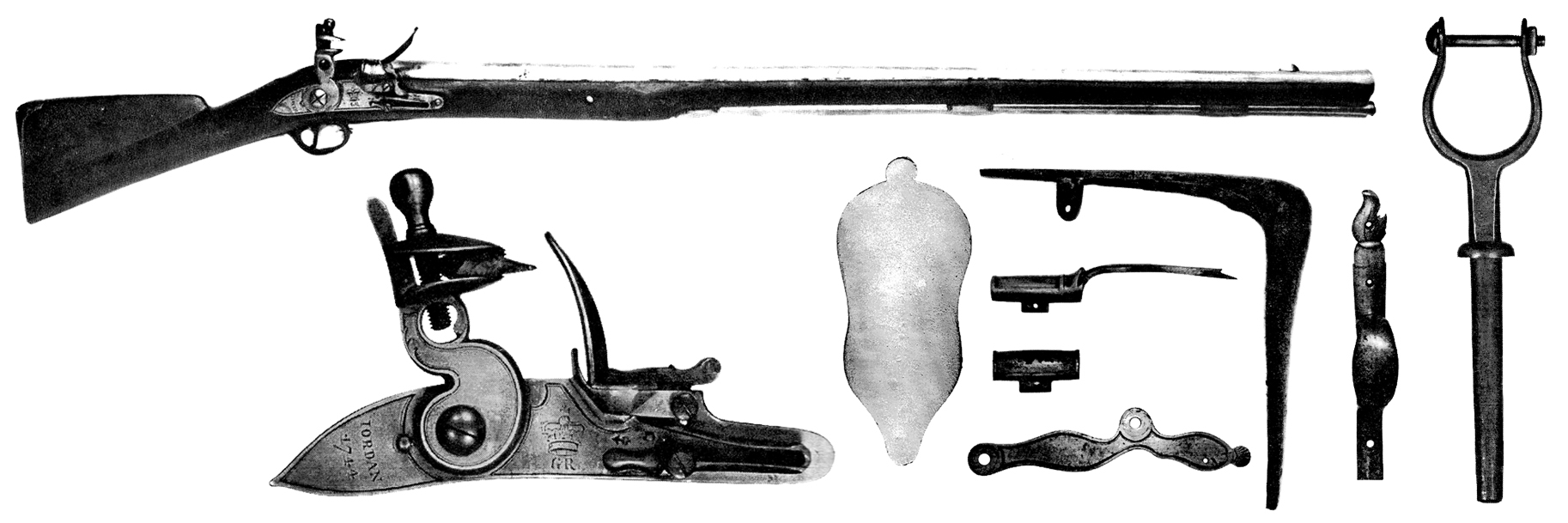 De Witt Bailey was kind enough to loan us his wall gun to copy. This gun has a 54″ tapered round barrel with a 1″ bore; it also has a lug on the barrel for a pivoting swivel yoke. Wall guns use a heavy iron ramrod and weigh approximately 34 pounds. These guns are a lot of gun to shoot and they are quite accurate. There is a letter on record that Washington had a few wall guns made up that were capable of hitting a sheet of common writing paper at 600 yards. The Yoke is not included in a parts set.
Pistols
Queen Anne Military Pistol (811)
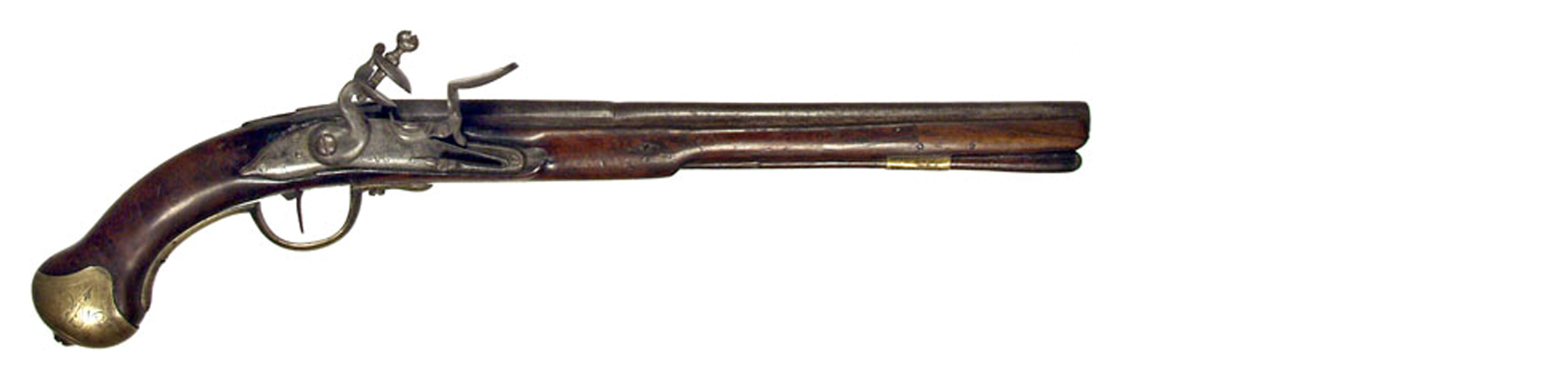
Thanks to Alex Chamberlain we now have this nice Queen Anne period dragoon pistol. These are beautiful early military pistols with large, slender and graceful styling. Nice round faced lock. It has a 14” octagon to round barrel, in .62 calibre.
Heavy Dragoon Pistol 1720-1760 (620)
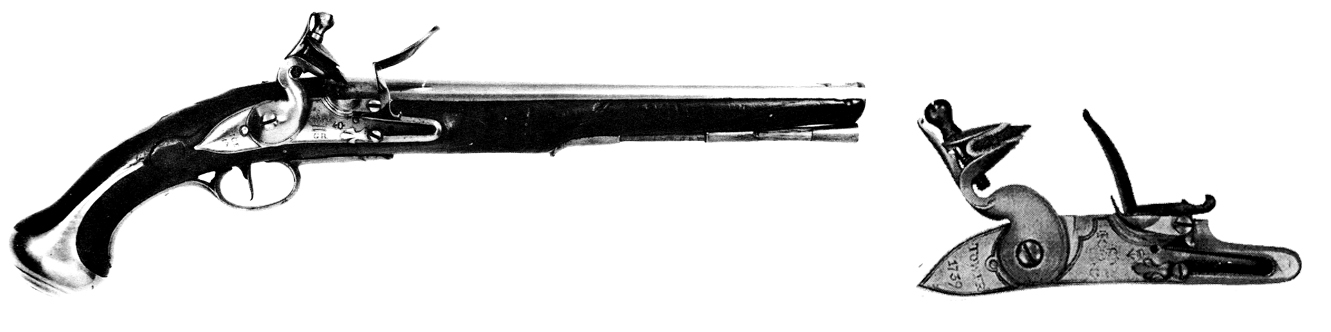 This is one of the most graceful pistols of the large English Military Pistols. We have reproduced all parts for this pistol in original size as well as the stock, in which we even put all the tang and lock panel moulding in place. Very widely used, it has a 12″ tapered round barrel in .62 or .66 calibre. The lock plate measures 5 1/2″ x 1″. The throw of the cock is 1 5/8″.
Early English Sea Service Pistol (559)
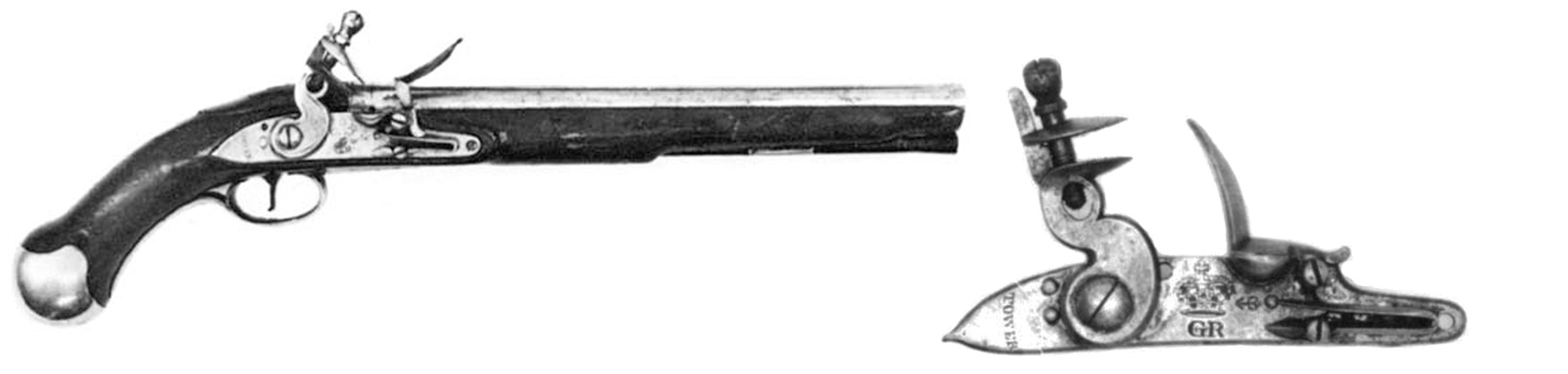
Phil Ackerman came up with this nice specimen which we copied. This is the early model 1777 Sea Service with the two screws showing behind the cock. This lock is also bridle-less with a round bottom pan. The 1756 pattern lock is identical, except that it has one screw showing behind the cock and has an octagonal pan. This pistol is all brass mounted except for the belt hook. It has a 12″ tapered round barrel in .62 calibre. The lock plate measures 5 3/16″ x 7/8″. The throw of the cock is 1 1/2″.
Late English Sea Service Pistol (567)
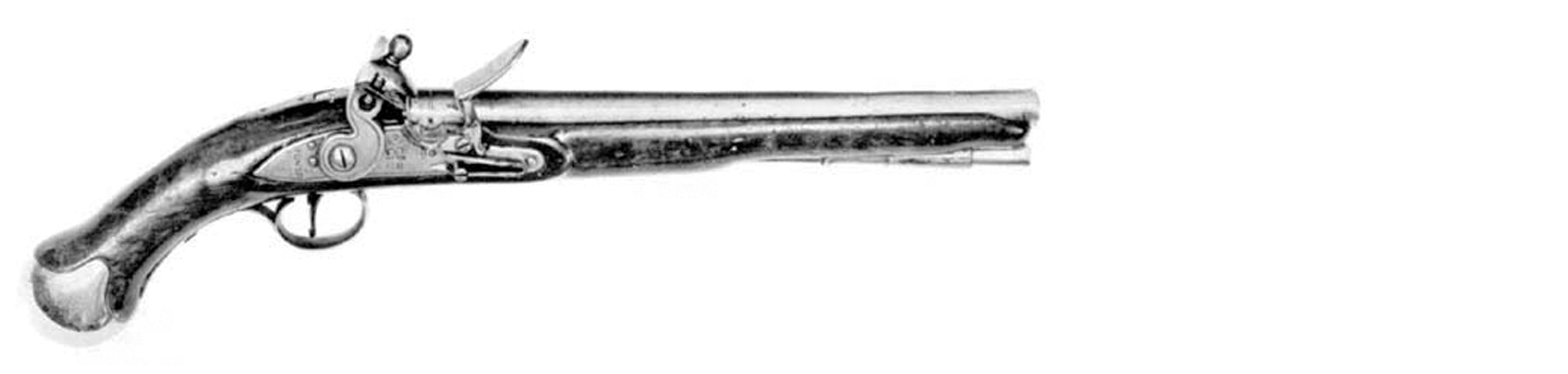
In the late 1780’s the Sea Service pistol was updated with a new double bridled lock and a flared front thimble. It has a 12″ round barrel in .62 calibre. This is basically the same gun as the previous Series (559) except for the lock and front thimble. The lock plate measures 5 3/16″ x 7/8″. The throw of the cock is 1 1/2″.
1756 Light Dragoon Pistol (917)
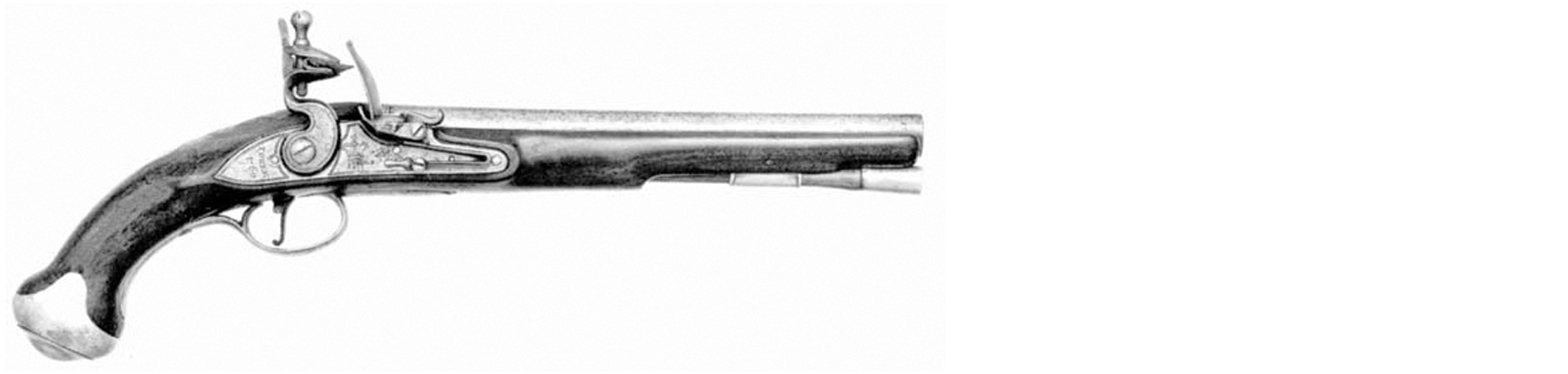
This new pistol came out in 1756, reducing the barrel length to 10”. The barrel was in .66 calibre, which was the same as the carbines. It now has a new flat lock.
“Eliott” Light Dragoon Pistol (568)
This is the light dragoon pistol of the 1760’s onward and widely used in the American Revolution. It is an all brass mounted pistol. It has a 9″ round barrel in .62 or .66 calibre. The round face lock plate measures 5 3/16″ x 1 5/16″. The throw of the cock is 1 1/2″.
1796 New Land Pattern Pistol (877)
This is one of the late land pattern flintlock Pistols produced with the new swivel ramrod. It has a 9″ barrel.
Scottish Pistol “Steel Framed” (532)
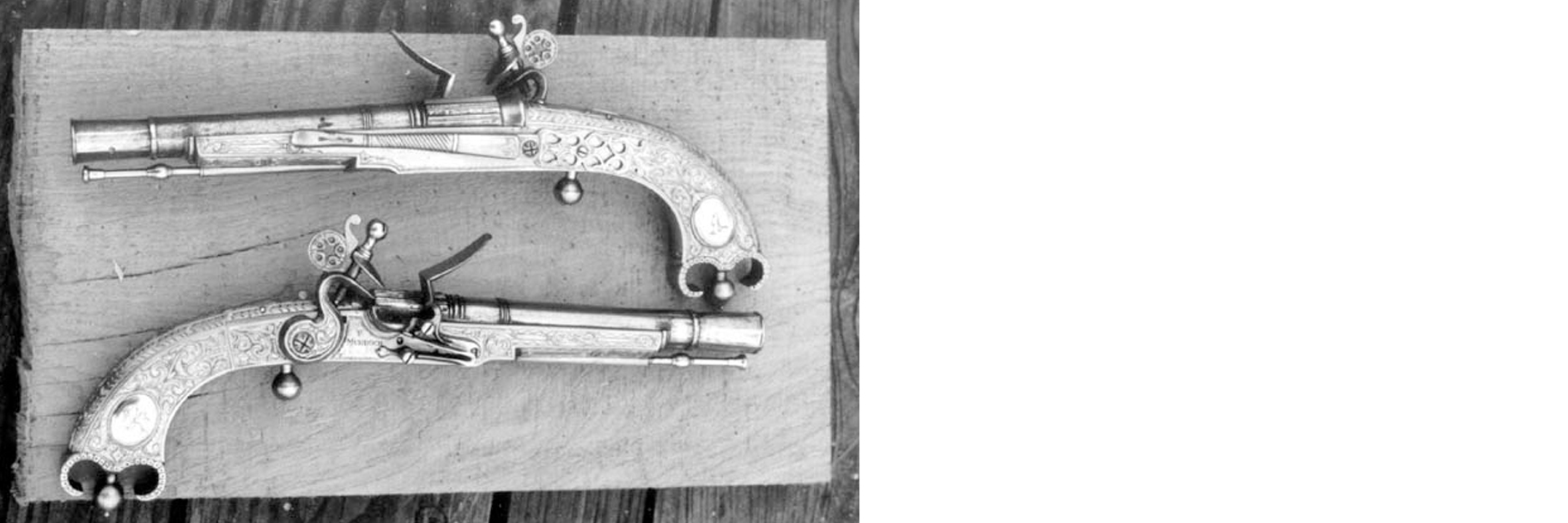
This nice early Scottish pistol has the early horizontal sear internals. The frame is cast in one piece. You will find these from very plain to profusely engraved like the one above. Ours is cast plain with no engraving. We have spent a lot of time on this set to be able to cast the frame in one piece. We make two barrels for this set, the plain round barrel for the military style or the ribbed style for the more elaborate pieces. The barrels are sold separately from the set of lock and frame castings.
Twigg Screwbarrel (646)
These small Boxlock pistols came into being around the 1720’s and were very popular well past the turn of the century. They were made in all barrel lengths and grip shapes. The one we copied here is by Twigg and of very good quality. These were sometimes fitted with small flip-out blades on the barrels. The throw of the cock is 1″. The nose is sized for a 9/16″ thread.
Brass Barrel Ketland Trade Pistol (637)
There are many of these pistols around that are well used and broken. This is the first we have found in very nice condition. Someone should do some research on these as there were many sent to America during the fur trade and are just as historical as the trade fusils. This one is from the Paul Tidwell collection. The lock plate measures 4 3/4″ x 7/8″. The cock has a 1.4 throw.
Twigg Officers Pistol (732)
Very high quality early Officers Pistol, in the 1760’s period by Twigg. Plain un-engraved mountings. It has a 7 1/4″ round barrel in .62 calibre. The overall length of the pistol is 13″. Perfect medium belt size pistol. The lock plate measures 4 1/2″ x 13/16″. The throw of the cock is 1 1/4″.
British Military Blunderbuss (822)
 Working with Ben Coogle we now have all the parts for this gun. The barrel has a .75 calibre bore and flares to 2″ at the muzzle. The lock and hardware are the same as the 1742 Model Brown Bess (542 B).
Non Military
Joe Manton Double Fowler (570)
Joe Manton was considered one of the best English Gunmakers of all time. He made more improvements to flint locks and shotguns than any other maker. His guns are a work of art in just functionality alone. Joe Manton brought the flintlock to its peak of perfection in speed and durability. The Late Lynton McKenzie helped us with these sets so you can build either a double or single late period fowler which will handle better than 90% of modern shotguns.
This set comes from the Late Lynton McKenzie Collection. These locks were made for the recessed breeches. The lock features, the full waterproof pans, antifriction wheels on frizzens which work against the cams on the frizzen springs to speed up the frizzen action and anti-friction internals which were all his latest improvements. The lock plates measure 4 1/2″ x 1″. The throw of the cock is 1 1/4″.
Ketland Blunderbuss (821)
This nice Ketland Blunderbuss is from the late Kit Ravenshear’s collection. The barrel is 15 1/2″ long with a .75 calibre bore. The lock and hardware are the same as our series (613).